
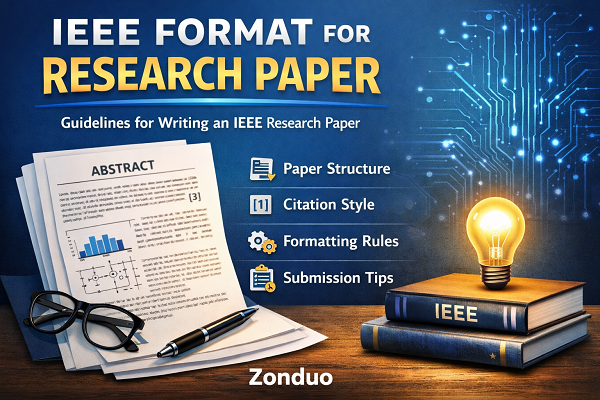
Writing a research paper requires accuracy, clarity, and strict formatting. Among all academic formats, the Ieee Format for Research Paper is one of the most widely accepted standards in engineering, technology, and scientific research. However, many students and researchers struggle to understand its structure and rules.
At Zonduo, we help scholars present their research professionally. This detailed guide explains the IEEE format step by step, making it easier to write a well-structured and publication-ready research paper.
What Is the IEEE Format for Research Paper?
The IEEE format is a standardized writing style developed by the Institute of Electrical and Electronics Engineers. It is commonly used in technical fields such as computer science, electronics, electrical engineering, and information technology.
The primary purpose of the IEEE format is to ensure uniformity, clarity, and easy readability across research publications. Since many international journals and conferences follow IEEE guidelines, understanding this format is essential for academic success.
Why IEEE Format Matters in Academic Writing
Using the correct Ieee Format for Research Paper improves the credibility of your work. Editors, reviewers, and readers expect consistency in structure and citation style.
Moreover, papers written in IEEE format appear more professional and organized. As a result, they have a higher chance of acceptance in reputed journals and conferences. Zonduo always recommends mastering IEEE guidelines early to avoid last-minute corrections.
General Formatting Rules in IEEE Style
Before starting the content, you must follow specific formatting rules.
The paper should be written in a two-column layout on A4 size paper. The font should be Times New Roman, with a font size of 10 for the main text. Margins must be uniform on all sides.
Additionally, the entire document should be single-spaced. Page numbers are usually not required unless specified by the publisher.
Title and Author Information
The title is the first element readers notice. In the Ieee Format for Research Paper, the title should be concise, informative, and centered at the top of the first page.
Author names, affiliations, and email addresses are placed below the title. This information is also centered and written in a smaller font size. Zonduo advises double-checking spelling and institutional details to avoid errors.
Abstract Writing in IEEE Format
The abstract is a brief summary of the research paper. It should be written in a single paragraph and should not exceed 250 words.
In IEEE format, the abstract must clearly state the research problem, methodology, results, and conclusion. Avoid citations and abbreviations in this section. A strong abstract increases the visibility of your research.
Keywords Section
After the abstract, keywords are listed. These keywords help search engines and academic databases index your paper.
When writing keywords, choose terms that accurately represent your research topic. For example, if your paper discusses formatting rules, including “Ieee Format for Research Paper” as a keyword improves discoverability.
Main Body Structure of IEEE Research Paper
The body of the paper is divided into numbered sections using Roman numerals.
Introduction
The introduction explains the background of the study, research objectives, and significance. It should engage readers and clearly define the problem being addressed.
Literature Review
This section discusses previous studies related to your topic. It helps establish the research gap and shows how your work contributes to existing knowledge.
Methodology
The methodology explains the research design, tools, data collection, and procedures. Clear explanation ensures reproducibility of results.
Results and Discussion
Here, you present findings using tables, figures, or graphs. Each figure should be numbered and referenced in the text. Discussion interprets the results logically.
Conclusion
The conclusion summarizes the research outcomes and highlights future scope. In IEEE format, conclusions should be concise and impactful.
Citation and Referencing Style in IEEE
Referencing is a critical part of the Ieee Format for Research Paper. IEEE follows a numbered citation system.
References are cited in the text using numbers in square brackets. The reference list appears at the end of the paper, arranged in the order of citation.
Each reference must include author name, title, publication source, year, and page numbers if applicable. Zonduo strongly recommends verifying references for accuracy.
Common Mistakes to Avoid in IEEE Format
Many researchers make formatting mistakes that can lead to rejection.
Common errors include incorrect font size, improper citation style, inconsistent headings, and poorly written abstracts. Additionally, using informal language reduces academic value.
By following IEEE guidelines carefully, you can avoid these issues and present a polished research paper.
How Zonduo Helps with IEEE Research Writing
At Zonduo, we understand the challenges of academic formatting. Our experts assist researchers in structuring, editing, and formatting papers according to IEEE standards.
Whether you are a student or a professional researcher, Zonduo ensures your paper meets publication requirements while maintaining originality and clarity.
Conclusion
Mastering the Ieee Format for Research Paper is essential for academic and professional success. From formatting rules to citations, every detail plays a crucial role in research presentation.
By following this guide and applying IEEE standards correctly, you can enhance the quality and acceptance rate of your research paper. With expert support from Zonduo, academic writing becomes simpler, structured, and more effective.